How to play kakuro
- Every white square gets one number from 1 to 9. Grey squares stay empty.
- A row of white squares between grey ones is an across run, a column of them is a down run. The clue for an across run sits in the grey square to its left, above the diagonal line; the clue for a down run sits in the grey square above it, below the line.
- The numbers in a run add up to its clue.
- A number can appear only once in a run. Two squares that add up to 4 are 1 and 3, never 2 and 2. The same number may appear again in another run.
How to solve kakuro
1. Find the runs with only one combination. Two squares that add up to 3 are always 1 and 2, and two that add up to 17 are always 8 and 9. Three squares that make 6 are 1, 2 and 3; three that make 24 are 7, 8 and 9. The table below lists all of them for runs of up to five squares.
2. Look where two runs cross. The shared square needs a number that both runs can use. In the picture, across 4 allows only 1 or 3 and down 3 allows only 1 or 2, so the shared square is 1. Then the other across square is 3 and the other down square is 2.
3. Small and large clues first. A low clue for a long run, or a high clue for a short one, leaves very few combinations. Clues in the middle (two squares making 10, say) have many, so leave them for later.
4. A number the run must have. If every combination of a run contains a 9, and only one of its squares can still take a 9, that square is the 9.
5. Keep pencil marks. Write the possible numbers small in the corner of each square and cross them off as the crossing runs rule them out. On screen, tap a square and the line under the grid lists the combinations of both its runs, keeping only the ones that fit the numbers you have already typed.
Kakuro cheat sheet
These clues have only one possible combination. They are the best place to start any kakuro.
| Squares in the run | Clues with one combination |
|---|---|
| 2 | 3 = 1+2, 4 = 1+3, 16 = 7+9, 17 = 8+9 |
| 3 | 6 = 1+2+3, 7 = 1+2+4, 23 = 6+8+9, 24 = 7+8+9 |
| 4 | 10 = 1+2+3+4, 11 = 1+2+3+5, 29 = 5+7+8+9, 30 = 6+7+8+9 |
| 5 | 15 = 1+2+3+4+5, 16 = 1+2+3+4+6, 34 = 4+6+7+8+9, 35 = 5+6+7+8+9 |
Kakuro runs follow the same rule as the cages of killer sudoku, so our full table of combinations works for kakuro too: every combination for runs of 2 to 9 squares, a calculator that narrows them down for the run you are stuck on, and a printable three-page cheat sheet.
Which level should I choose?
| Level | Grid | What it takes | Time |
|---|---|---|---|
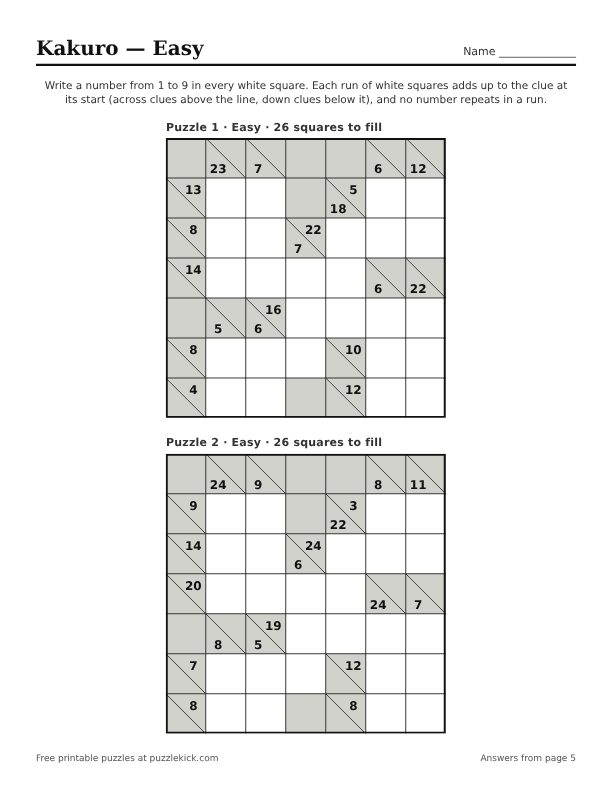
| Easy | 6×6, about 26 white squares, runs up to 4 | Short runs and many one-combination clues. Knowing which numbers a clue allows, and crossing it with the other run, is enough. A good first kakuro. | 10–20 min |
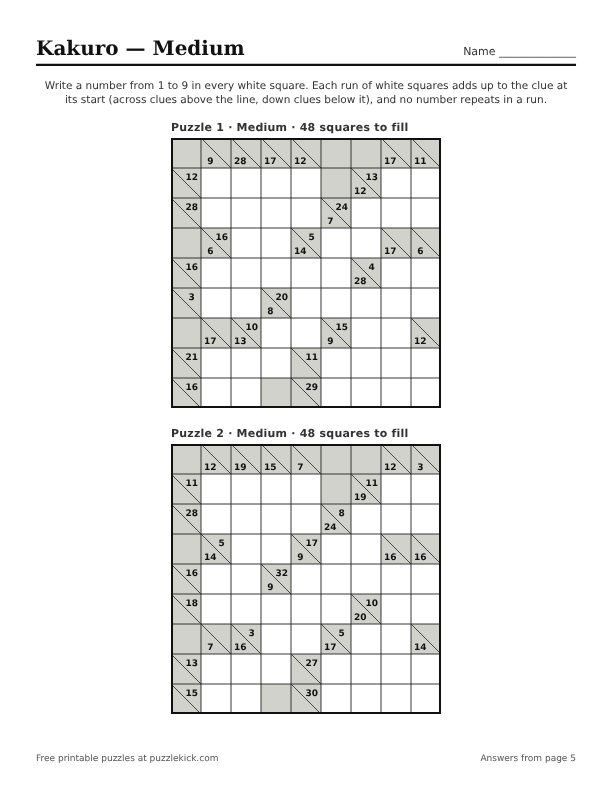
| Medium | 8×8, about 47 white squares, runs up to 5 | Longer runs. Sometimes you need to try the combinations of a run against its squares one by one. | 20–40 min |
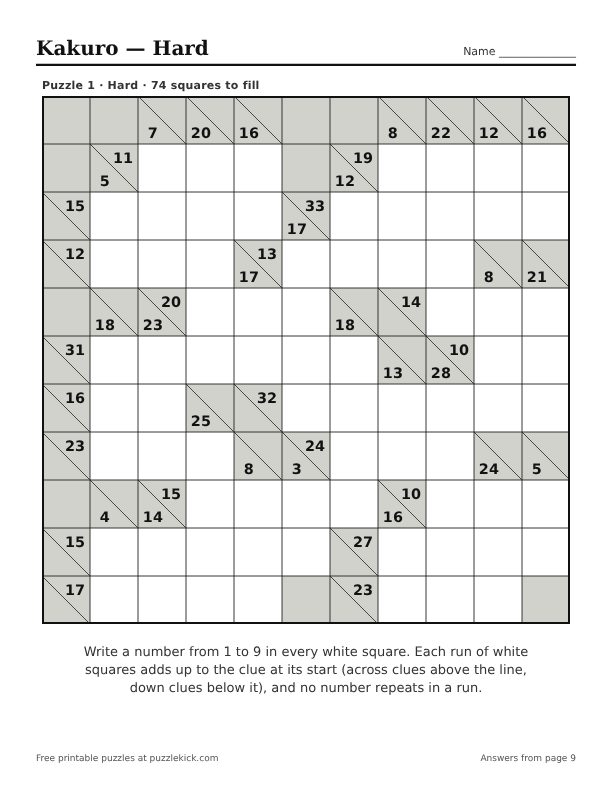
| Hard | 10×10, about 75 white squares, runs up to 6 | A big grid that cannot be finished by the simple steps alone. One per page in the PDF. Still no guessing. | 40–75 min |
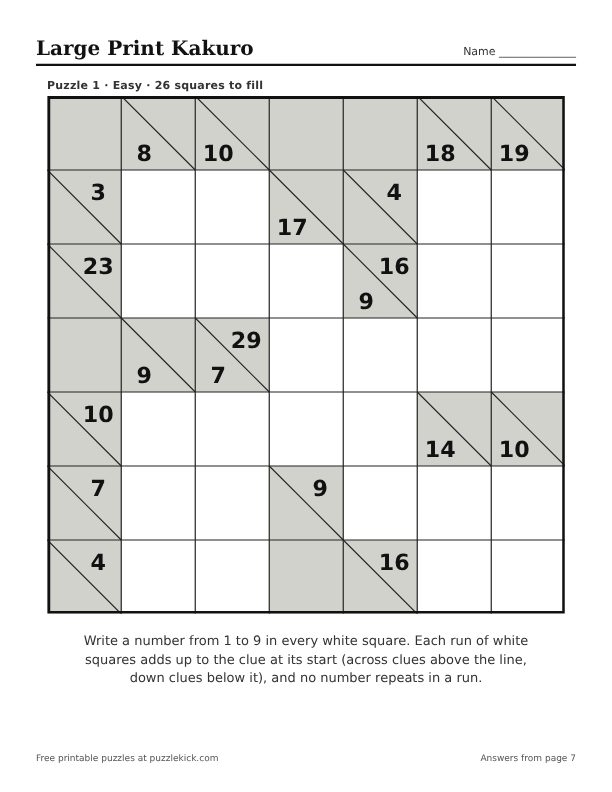
| Large print | 6×6 | Easy puzzles, one per page, with squares close to an inch wide and big clues. | 10–20 min |
Large print kakuro for seniors
The clues in the grey squares are the small print of kakuro, so the large print PDF gives one easy puzzle per page with squares close to an inch wide and bold clues. Kakuro needs nothing harder than adding up small numbers, which makes it a friendly number puzzle for anyone who enjoys sudoku. Activity leaders can print a stack for a puzzle table; the answers are at the back. Keep a copy of the cheat sheet on the table, too.
Printing tips
The easy and medium PDFs fit two puzzles on a US Letter page; hard and large print puzzles get a page each. On A4 paper, choose “Fit to page” in the print window. The grey squares are a light grey that saves ink and still prints clearly on a black and white printer.
Questions
What is kakuro?
A number puzzle laid out like a crossword. Instead of words, you write the numbers 1 to 9 in the white squares so that every run adds up to its clue, without repeating a number in a run.
Is kakuro the same as cross sums?
Yes. Cross sums is the older American name for the same puzzle; kakuro is the shorter name it got in Japan, and it is now used around the world.
Do I need to be good at math?
No. You only add small numbers, and the cheat sheet does even that for you. Kakuro is really about logic: finding the one number that fits both runs of a square.
Is there only one correct answer?
Yes. Every puzzle is solved by computer using only the steps described on this page, and then checked again by a separate search, so each one has exactly one solution and never needs guessing.
Can I print copies for my group or class?
Yes. The puzzles are free for personal, classroom and group use, such as clubs, libraries and senior centers.