All 25 science trivia questions with answers
What is the chemical formula for water?
A. H₂OB. NaClC. CO₂D. HO₂
Show answer
A. H₂O Two hydrogen atoms joined to one oxygen atom; CO₂ is carbon dioxide and NaCl is table salt.
How many planets are in our solar system?
A. 9B. 10C. 8D. 7
Show answer
C. 8 Pluto was counted as the ninth until 2006, when it was reclassified as a dwarf planet.
At what temperature does water boil at sea level on the Fahrenheit scale?
A. 100 degreesB. 212 degreesC. 180 degreesD. 200 degrees
Show answer
B. 212 degrees That is 100 degrees Celsius; high in the mountains water boils at a lower temperature.
Who developed the theory of relativity?
A. Albert EinsteinB. Isaac NewtonC. Max PlanckD. Niels Bohr
Show answer
A. Albert Einstein His famous equation, E = mc², came out of his special theory of relativity in 1905.
What is the center of an atom called?
A. OrbitB. ElectronC. NucleusD. Molecule
Show answer
C. Nucleus It holds the protons and neutrons, and the electrons move around it.
Which force keeps the planets moving around the Sun?
A. MagnetismB. Static electricityC. FrictionD. Gravity
Show answer
D. Gravity Isaac Newton described the law of universal gravitation in 1687.
Which scientist wrote “On the Origin of Species” (1859)?
A. Carl LinnaeusB. Louis PasteurC. Charles DarwinD. Gregor Mendel
Show answer
C. Charles Darwin His ideas grew from a five-year voyage on HMS Beagle that took him to the Galápagos Islands.
Who was the first woman to win a Nobel Prize, and the first person to win two?
A. Rosalind FranklinB. Ada LovelaceC. Lise MeitnerD. Marie Curie
Show answer
D. Marie Curie She won for physics in 1903 and for chemistry in 1911.
What kind of rock forms when lava or magma cools?
A. LimestoneB. MetamorphicC. IgneousD. Sedimentary
Show answer
C. Igneous Granite and basalt are both igneous rocks.
In 1953, which two scientists described the double helix of DNA?
A. Watson and CrickB. Pasteur and KochC. Banting and BestD. Curie and Becquerel
Show answer
A. Watson and Crick Their model drew on X-ray pictures of DNA made by Rosalind Franklin.
Which unit measures electrical resistance?
A. VoltB. OhmC. AmpereD. Watt
Show answer
B. Ohm It is named after the German physicist Georg Ohm.
What is the most common element in the universe?
A. CarbonB. HydrogenC. HeliumD. Oxygen
Show answer
B. Hydrogen Stars like the Sun shine by fusing hydrogen into helium.
What is the pH of pure water?
A. 0B. 7C. 5D. 14
Show answer
B. 7 Below 7 is acidic, like lemon juice; above 7 is basic, like baking soda.
Which American flew a kite in a thunderstorm to show that lightning is electricity?
A. Benjamin FranklinB. Alexander Graham BellC. Samuel MorseD. Thomas Edison
Show answer
A. Benjamin Franklin The famous kite experiment took place in Philadelphia in 1752.
How long does it take the Earth to travel once around the Sun?
A. Exactly 365 daysB. About 366 and a half daysC. About 365 and a quarter daysD. Exactly 360 days
Show answer
C. About 365 and a quarter days The extra quarter of a day is why a leap day is added almost every four years.
Which layer of gas high above the Earth blocks much of the Sun’s ultraviolet light?
A. The ozone layerB. The magnetosphereC. The jet streamD. The troposphere
Show answer
A. The ozone layer Ozone is a form of oxygen with three atoms instead of two.
What kind of energy does a moving object have?
A. Potential energyB. Chemical energyC. Thermal energyD. Kinetic energy
Show answer
D. Kinetic energy A ball held up high has potential energy, which turns into kinetic energy as it falls.
Which blood cells fight infections?
A. Nerve cellsB. Red blood cellsC. PlateletsD. White blood cells
Show answer
D. White blood cells Red blood cells carry oxygen, and platelets help the blood to clot.
How many chambers does the human heart have?
A. 4B. 3C. 6D. 2
Show answer
A. 4 Two atria at the top take in blood, and two ventricles below pump it out.
What is the study of earthquakes called?
A. SeismologyB. VolcanologyC. MeteorologyD. Geography
Show answer
A. Seismology Scientists record the shaking of the ground with an instrument called a seismograph.
What is absolute zero on the Celsius scale?
A. −459.67 degreesB. −100 degreesC. −212 degreesD. −273.15 degrees
Show answer
D. −273.15 degrees It is the coldest anything can ever be: −459.67 degrees Fahrenheit, or 0 on the Kelvin scale.
Which planet is often called the Morning Star or the Evening Star?
A. MercuryB. SaturnC. MarsD. Venus
Show answer
D. Venus After the Moon, it is the brightest natural object in the night sky.
Which organ makes insulin?
A. SpleenB. LiverC. PancreasD. Kidney
Show answer
C. Pancreas Insulin helps the cells of the body take in sugar from the blood.
Who named the cell after looking at thin slices of cork under a microscope in 1665?
A. Antonie van LeeuwenhoekB. Robert HookeC. Isaac NewtonD. Galileo Galilei
Show answer
B. Robert Hooke He called the tiny boxes cells, from the Latin word for a small room.
About how long does sunlight take to reach the Earth?
A. About 1 minuteB. About 8 minutesC. About 8 secondsD. About 8 hours
Show answer
B. About 8 minutes Light travels about 186,000 miles a second, and the Sun is about 93 million miles away.
Hosting tip
Give every team a scrap of paper for working things out, and allow one “ask a scientist” per round: the team may ask any one person in the room for help. Read the facts aloud slowly. Science facts are the ones people repeat at breakfast the next day.
Questions
What level are these science questions?
About high school level. Most adults will know the chemical formula for water or the number of planets, and a few, such as the unit of electrical resistance or absolute zero, are harder.
Can teachers use them in class?
Yes. The quiz works as a review game for middle and high school science, and the printable PDF has an answer key with a short explanation for every answer.
More trivia questions
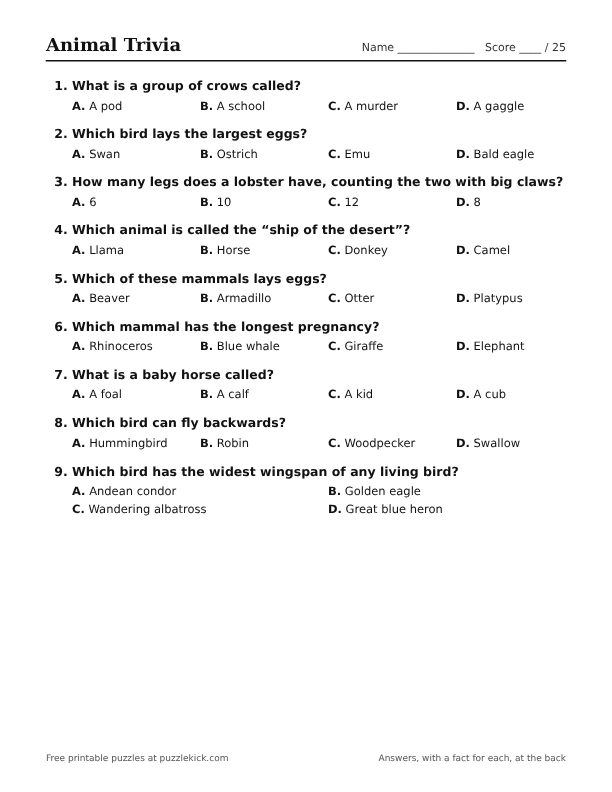 25 questions · answers
Animal Trivia
What is a group of crows called?
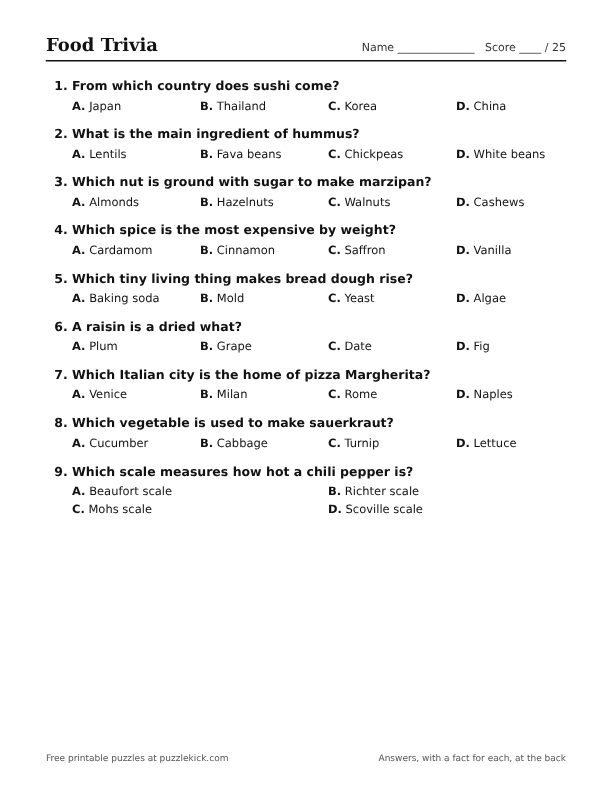 25 questions · answers
Food Trivia
From which country does sushi come?
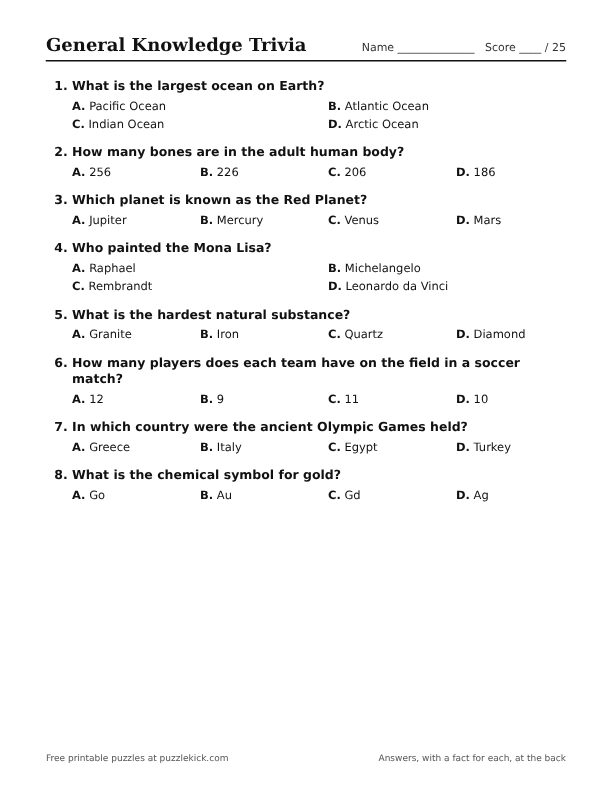 25 questions · answers
General Knowledge Trivia
What is the largest ocean on Earth?
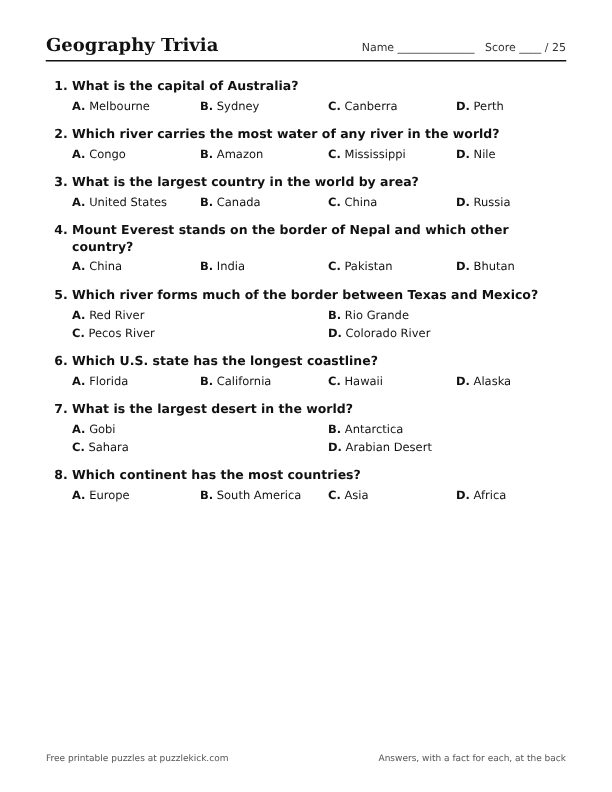 25 questions · answers
Geography Trivia
What is the capital of Australia?
All trivia questions · Trivia team names · Large print trivia for seniors