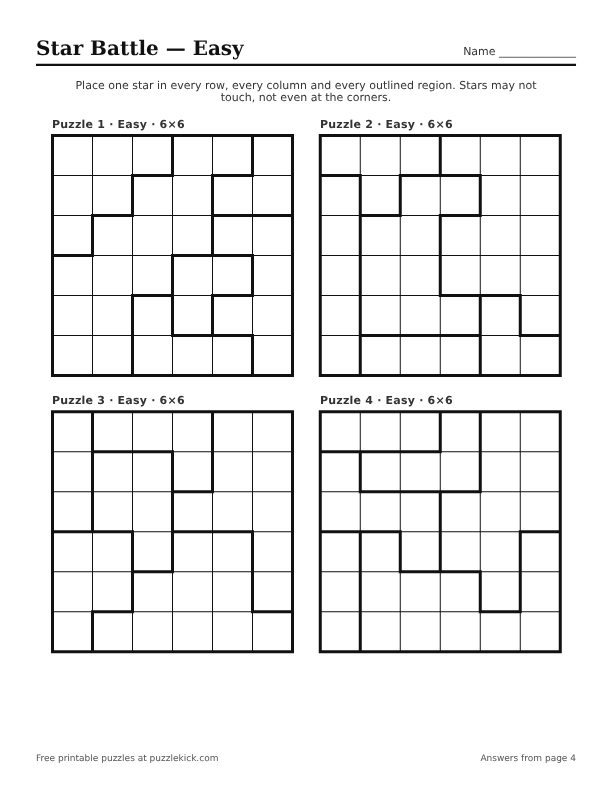
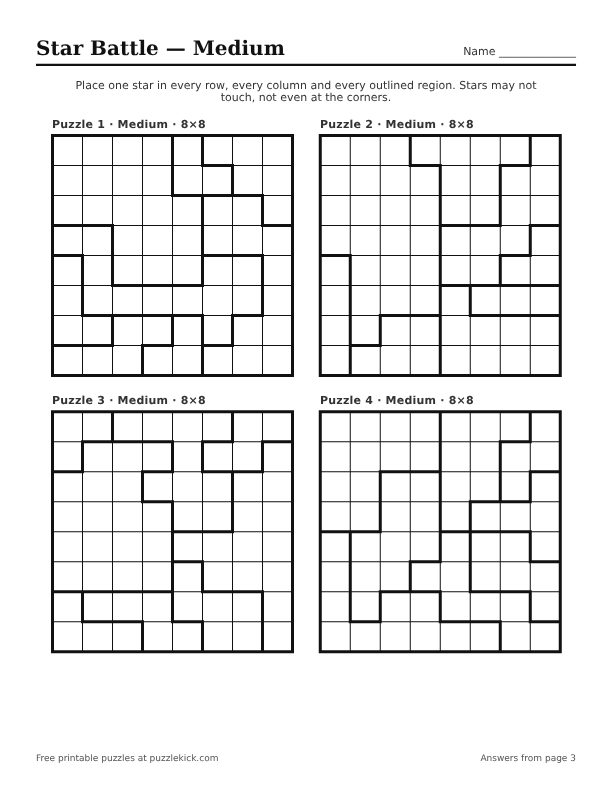
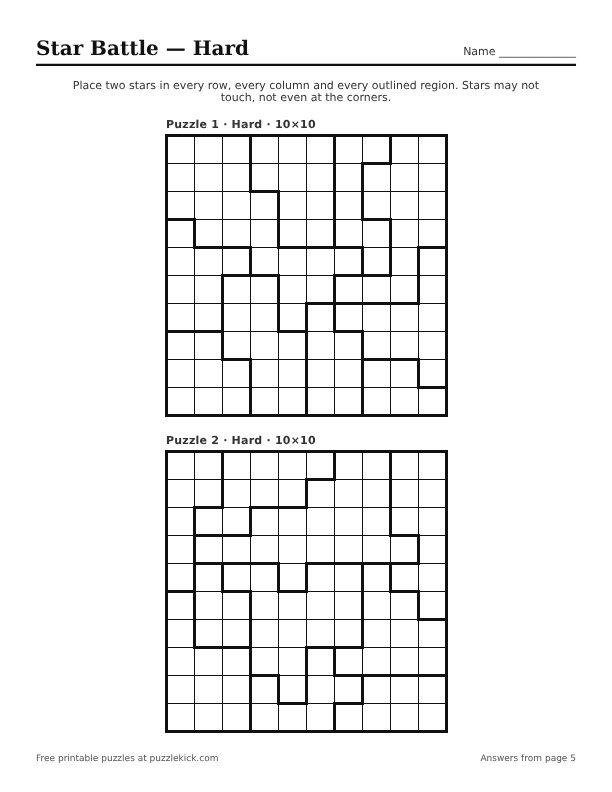
How to play Star Battle
- Thick lines split the grid into regions (on screen they are also softly colored). A 6×6 grid has six regions, an 8×8 grid eight, and so on.
- On the easy and medium puzzles, place one star in every row, every column and every region. On the hard 10×10 puzzles, place two stars in each.
- Stars may not touch each other, not even diagonally. So every star rules out the eight squares around it.
- On screen, tap a square once to put a dot in it (a reminder that no star can go there), twice for a star, and a third time to clear it.
How to solve, step by step
- Dot around every star. As soon as you place a star, dot its eight neighbors and the rest of its row, column and region (the checkbox does this for you on screen). Most of the puzzle is solved by these dots.
- Start with the small regions. A region of two or three squares has very few places for its star. If a region sits entirely inside one row, that row’s star must be in that region, so dot the rest of the row.
- Look for the square they all touch. If every square still open in a region touches the same outside square, that square can never hold a star: whichever square gets the region’s star, it would be its neighbor.
- Count regions in bands of rows. If two regions fit entirely inside the same two rows, those two rows’ stars all belong to those two regions, so every other square in the two rows gets a dot. It works for any number of rows or columns and the same number of regions.
- Ask “what if?” If a star in a square would leave some row, column or region with no room for its own star, that square gets a dot.
- On two-star puzzles, remember that if a row needs two stars and has only three open squares left, side by side, the stars must take the two ends. And a 2×2 block can never hold more than one star, because any two of its squares touch.
Which level should I choose?
| Level | Grid | What it takes | Time |
|---|---|---|---|
| Easy | 6×6, one star each | Dot around the stars and look at the small regions. A good first Star Battle. | 5–10 min |
| Medium | 8×8, one star each | You will also need bands of rows or columns, or a “what if?” step, at least once. | 10–20 min |
| Hard | 10×10, two stars each | The classic size. Two stars in every row, column and region make for a long, satisfying solve. | 20–40 min |
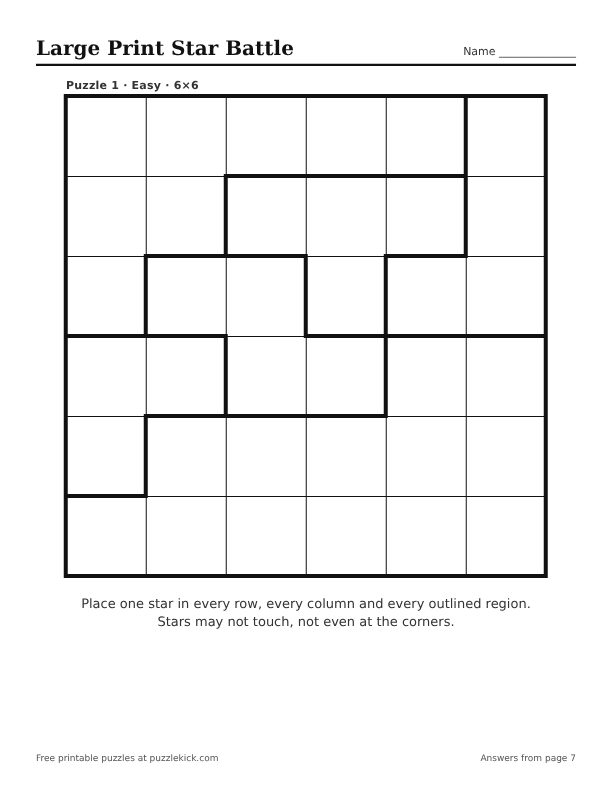
| Large print | 6×6, one star each | Easy puzzles, one per page, with squares more than an inch wide and extra-thick region lines. | 5–10 min |
Large print Star Battle for seniors
Star Battle needs no vocabulary, no trivia and no arithmetic, which makes it a fair game for everyone at the table. The large print PDF gives one easy 6×6 puzzle per page, with big squares that are easy to dot and star with a pencil, and the answers at the back. For more puzzles that use pure reasoning, try our logic grid puzzles or the jigsaw sudoku.
Questions
What is a Star Battle puzzle?
A logic puzzle on a square grid divided into regions. You place stars so that every row, column and region holds the same number of stars and no two stars touch, even diagonally. It was invented by puzzle designer Hans Eendebak and first used at the World Puzzle Championship in 2003.
How many stars go in each row?
On our easy (6x6) and medium (8x8) puzzles, one star in every row, column and region. On the hard 10x10 puzzles, two stars in each, which is the size used in most puzzle books and contests.
Do I ever need to guess?
No. Every puzzle is checked by computer to have exactly one solution, and our solver finishes each one by reasoning alone, using the moves described on this page.
What do the dots mean?
A dot is your own note that a square cannot hold a star. Dots are not part of the answer; they simply make the remaining squares easier to see. On screen, the checkbox adds them for you around every star you place.
Can I print copies for my group or class?
Yes. The puzzles are free for personal, classroom and group use, such as clubs, libraries and senior centers.