How to keep score in bowling
A game has ten frames. In each of the first nine, a bowler has up to two balls to knock down all ten pins. Write the result in the small boxes at the top of the frame and the running total underneath:
- Strike (X): all ten pins with the first ball. The frame scores 10 plus the pins from the bowler’s next two balls. In frames 1 to 9 the X goes in the right-hand box.
- Spare (/): the rest of the pins with the second ball. The frame scores 10 plus the pins from the next ball.
- Open frame: pins left standing after two balls. Write both counts; the frame scores the pins knocked down. A dash (–) means a miss.
After a strike or a spare the total for that frame has to wait for the next ball or two, so it is normal to leave a frame blank for a moment and fill it in later. To check your adding, enter the balls in our bowling score calculator.
The tenth frame is different: a strike earns two more balls and a spare one more, so a bowler can throw up to three balls there, and each gets its own box. Twelve strikes in a row make a perfect game of 300.
An example game, frame by frame
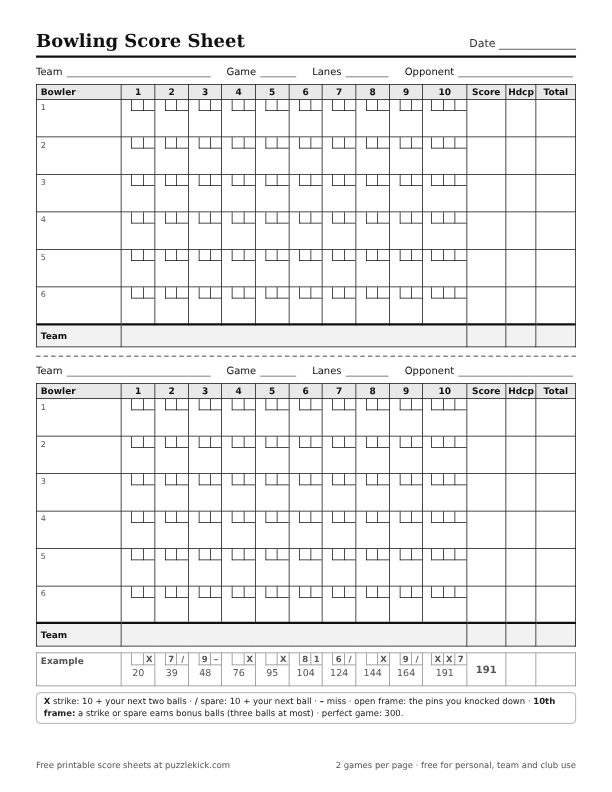
This is the example printed at the bottom of the sheet. It ends at 191.
| Frame | Marks | How it scores | Total |
|---|---|---|---|
| 1 | X | Strike: 10 + the next two balls (7 and 3) = 20 | 20 |
| 2 | 7 / | Spare (7, then the other 3): 10 + the next ball (9) = 19 | 39 |
| 3 | 9 – | Open frame: 9 + 0 (a miss) = 9 | 48 |
| 4 | X | Strike: 10 + the next two balls (10 and 8) = 28 | 76 |
| 5 | X | Strike: 10 + the next two balls (8 and 1) = 19 | 95 |
| 6 | 8 1 | Open frame: 8 + 1 = 9 | 104 |
| 7 | 6 / | Spare (6, then the other 4): 10 + the next ball (10) = 20 | 124 |
| 8 | X | Strike: 10 + the next two balls (9 and 1) = 20 | 144 |
| 9 | 9 / | Spare (9, then the other 1): 10 + the next ball (10) = 20 | 164 |
| 10 | X X 7 | A strike earns two more balls: 10 + 10 + 7 = 27 | 191 |
Handicap
Many leagues add a handicap so that bowlers with different averages can compete fairly. Each league picks its own formula; common ones take 80% or 90% of the difference between a base score (often 200, 210 or 220) and the bowler’s average, with fractions dropped. With 90% of 220, a bowler who averages 160 gets 54 pins added to every game. Write the handicap in the Hdcp column and the score plus handicap under Total. The bowling handicap calculator works it out for any league formula.
Bowling with a group
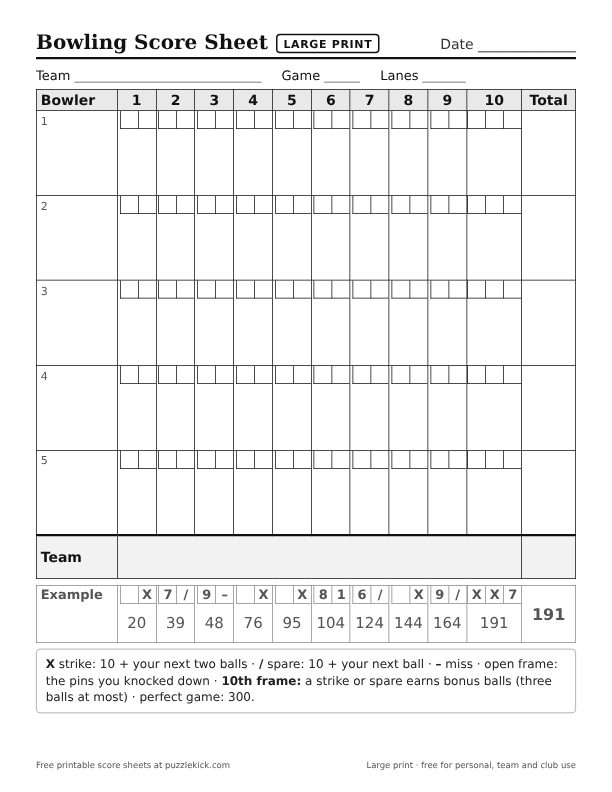
Printed sheets are handy wherever there is no automatic scoring: backyard and tabletop sets, church and senior center outings, a school gym, or a TV bowling game played as a league. The scoring is the same ten-pin scoring in all of them. For older eyes, the large print sheet has bigger boxes and type; one person can keep score for a whole lane and read the totals aloud.
Questions
What is a perfect game in bowling?
A score of 300: twelve strikes in a row, one in each of the first nine frames and three in the tenth.
How do I mark a foul or a split?
A foul (stepping over the foul line) counts zero for that ball; write F in its box. Many scorekeepers circle the first-ball count when it leaves a split, so it is easy to see later.
Can I use the sheet for a kids’ party or bumper bowling?
Yes. The scoring is the same, and the regular sheet has room for six bowlers per game, so one sheet covers two games for a small party.
Will it print on A4 paper?
Yes. The sheet is made for US Letter; choose “Fit to page” in the print settings and it shrinks slightly to fit A4.