How to play dots and boxes
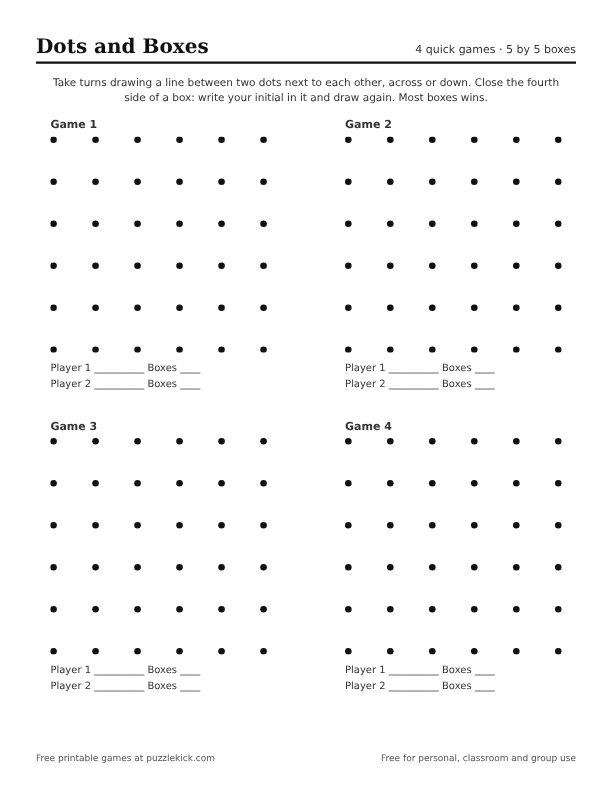
- Start with a grid of dots. A square of 5 by 5 boxes (6 dots on each side) is a good size for a first game on paper.
- Players take turns drawing one line that joins two dots next to each other, across or down. No diagonal lines.
- If your line closes the fourth side of a box, write your initial inside it and draw another line. One line can close two boxes at once, and you keep going as long as you close boxes.
- When every box is closed, the player with the most boxes wins.
How to win at dots and boxes
1. Don’t draw the third side of a box. A box with three sides is a free gift: the other player closes it and moves again. Early in the game there are plenty of safe lines, so never give a box away.
2. Watch the chains. Sooner or later every line gives something away. By then the boxes have joined into chains, and sometimes loops: a line drawn anywhere in a chain lets the other player take every box in it, one after another. When you have to give something away, give the shortest chain.
Open a chain of two boxes with the line between them, not at an end. That way your opponent can only take both; they can not use the trick below on you.
3. The all-but-two trick. When your opponent hands you a long chain, you do not have to take all of it. Take all but the last two boxes, then draw the line at the far end. Your opponent can take those two boxes with a single line, but then has to move again, and every move left opens the next chain for you. Two boxes is a small price for the next chain, and the one after it. In a loop, the same trick leaves four boxes, two pairs.
It is often called the double-cross, because your opponent’s one line then takes two boxes at once. Take every box only when the chains still to come are too short to be worth it, or on the very last chain.
4. Count the long chains. A chain of three or more boxes is a long chain. Once both players know the all-but-two trick, the player who has to open the first long chain usually loses, so the real fight is over how many long chains the board will have. Mathematician Elwyn Berlekamp put it as the long chain rule: on a board of m rows and n columns of boxes, if both m and n are even, the first player wants an odd number of long chains; otherwise the first player wants an even number. The second player wants the opposite, and loops do not count. So on our 3×3 and 5×5 boards, the player who moves first wants an even number of long chains; on 4×4 and 6×6, an odd number.
5. Change the count on purpose. Before the safe lines run out, joining two short chains into one long chain, or cutting a long chain in two, changes the count. Giving away a box or two early can be worth it if it leaves your opponent opening the first long chain.
Playing against the computer
| Level | How the computer plays |
|---|---|
| Easy | Takes a box when it can, but now and then draws a careless third side and gives boxes away. Good for children and for learning the rules. |
| Medium | Never gives a box away while a safe line is left, and then hands over the smallest group of boxes it can. It does not know the all-but-two trick. |
| Hard | Plays the chains and loops at the end the way experts do, uses the all-but-two trick when it pays, and once twenty or fewer lines are left it works out every possible ending, so it does not make a mistake from there. To beat it, win the fight over the long chains before that. |
Dots and boxes for seniors and families
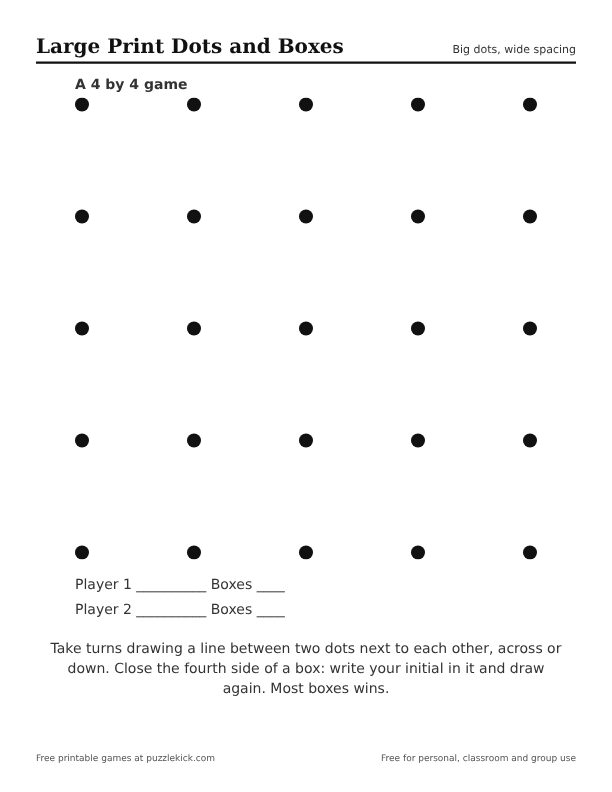
Dots and boxes needs only a pencil and a sheet of dots, and one game takes a few minutes, which makes it a good game for a grandparent and a grandchild, or for two friends at a senior center. The large print sheets have big dots with more than an inch between them, so the lines are easy to draw and the boxes easy to count. Use two pencil colors instead of initials if that is easier to see. For a calmer game for one, try our printable mazes or dot to dot pictures.
Where the game comes from
Dots and boxes was first published in the 19th century by the French mathematician Édouard Lucas, who called it la pipopipette. It has had many names since, among them the game of dots, dots and dashes, dot to dot grid, boxes and pigs in a pen. In 2000 Elwyn Berlekamp, an American mathematician, wrote a whole book about its strategy.
Printing tips
The game sheets print on US Letter paper: four quick games of 5 by 5 boxes on the first page, two games of 7 by 7 on the second, and one long game of 10 by 12 boxes on the third. On A4 paper, choose “Fit to page” in the print window. Print a stack and keep it with the pencils for rainy days.
Questions
Do you get another turn after closing a box?
Yes. Each time your line closes a box, you write your initial in it and draw another line. That is what makes chains so valuable.
What size board is best?
A 3 by 3 board is a quick game for beginners and children. 4 by 4 and 5 by 5 boards give the chains room to form, and 5 by 5 is a favorite of experienced players. The long game on our printable sheet, 10 by 12 boxes, is for an evening with a patient opponent.
Is it better to go first?
There is no simple advantage you can count on. What decides most games between good players is who has to open the first long chain, and that depends on the size of the board and on how the chains form.
What is the double-cross in dots and boxes?
It is the all-but-two trick: instead of taking a whole chain, you take all but the last two boxes and draw the line at the far end, so your opponent gets two boxes with one line and then has to open the next chain for you.
Can I print copies for my class or group?
Yes. The sheets are free for personal, classroom and group use, such as clubs, libraries and senior centers.