Which level should I choose?
| Level | Dots | What it is like |
|---|---|---|
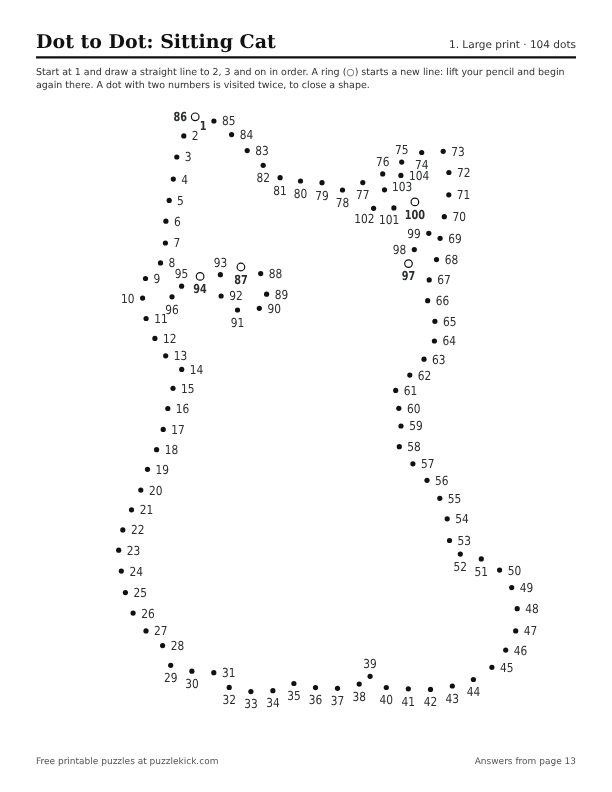
| Large print | 102–114 | Big 12.5-point numbers and plenty of space between dots. Mostly the outline of the picture, in one or a few lines. A relaxed 10 to 20 minutes, and easy on the eyes. |
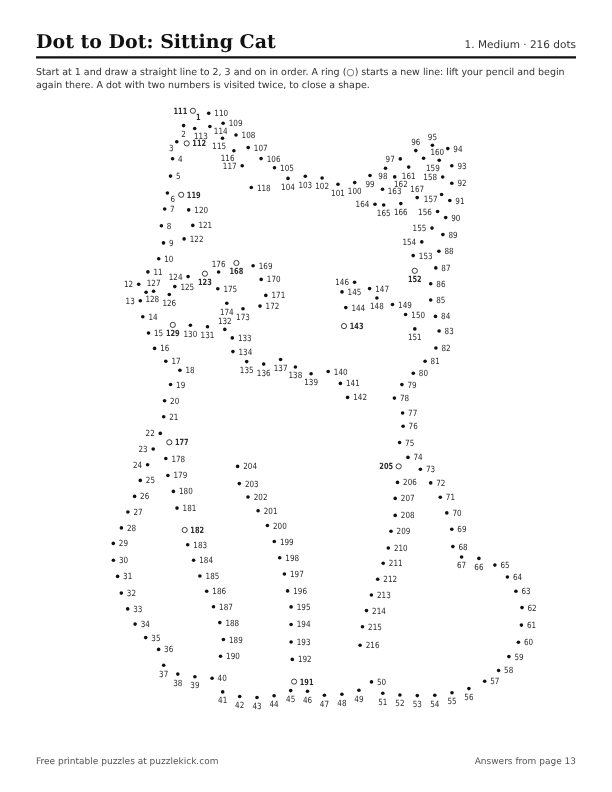
| Medium | 207–235 | The outline plus the main lines inside it, such as eyes, legs and petals. Numbers about the size of newspaper print. Around half an hour. |
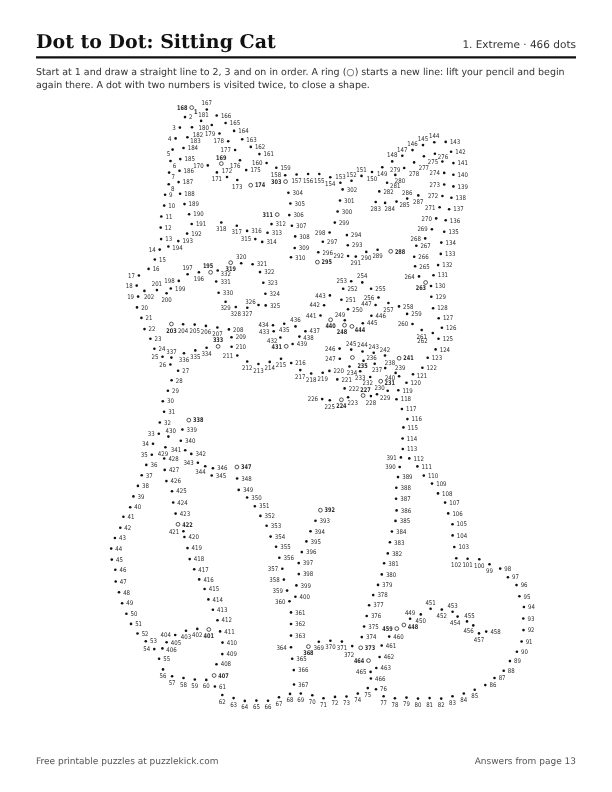
| Extreme | 451–518 | An extreme dot to dot: small numbers packed close together and many separate lines, so the picture shows its details. Plan on an hour or more, and good light. |
How to do a dot to dot puzzle
- Find number 1. It sits next to a small ring (○), like every dot where a new line begins.
- Draw a straight line from 1 to 2, then to 3, and keep going in order. A ruler is not needed; a sharp pencil or a fine pen works best.
- When the next number has a ring, lift your pencil and start a new line there. The two dots are not joined.
- Some dots have two numbers, for example 1 and 86 on the sitting cat in large print. That dot is used twice: the last dot of a shape joins back to its first one to close it.
- When every number is joined, compare your picture with page 2 of the PDF. Then, if you like, color it in.
Tips for an easy start
- Pick the right size. If small print is hard to read, start with large print. You can also print any PDF on 11×17 inch paper with “Fit to page” for even bigger numbers.
- Mark your place. On the bigger puzzles, put a light tick by every tenth number as you pass it. When you come back after a break, you know where you stopped.
- Search in a circle. The next number is almost always close to the last one. If it is not right beside it, look for a ring nearby: a new line is starting.
- Use a pencil first. On extreme puzzles a wrong line is easy to make in a crowded corner. A pencil lets you fix it, and you can go over the lines in pen at the end.
- Keep it a surprise. For a group, cover the title when you copy the page, and let everyone guess the picture as it appears.
For activity directors and groups
Dot to dot needs no explaining, no reading and no right or wrong guesses, which makes it a calm table activity for mixed groups. Give large print to anyone who finds small numbers tiring and medium or extreme to those who want a longer project. The finished outlines double as coloring pages, so a session can move straight on to colored pencils. The pictures come from our own coloring pages: a program traces each one and spaces the dots evenly along its lines, then checks that no number covers a dot or another number.
More quiet pencil puzzles for a group: printable mazes, color by number for adults and the large print puzzles for seniors.
Questions
What is a dot to dot for adults?
The same idea as the dot to dot puzzles many of us did as children, made bigger: hundreds of numbered dots instead of a few dozen, so the picture stays hidden until most of the lines are drawn. Our extreme dot to dot level, the hardest, has up to 518 dots per picture.
Is dot to dot the same as connect the dots?
Yes. Dot to dot, connect the dots and join the dots are three names for the same puzzle: you draw a line from each numbered dot to the next until the picture appears. Every puzzle on this page works that way, from large print to extreme.
What do the rings mean?
A ring marks the first dot of a new line. When you reach it, do not join it to the dot before; lift your pencil and start again from the ring.
Why do some dots have two numbers?
That dot is visited twice. It is the first dot of a closed shape, such as the outline of the cat, and the second number tells you when to come back to it and close the shape.
Is the answer included?
Yes. Page 2 of every PDF shows the finished picture, and the PDFs with all 12 pictures have the answers at the back, four to a page.
Can I print copies for my group or class?
Yes. The puzzles are free for personal, classroom and group use, such as clubs, libraries and senior centers.
Can I do it on a phone or tablet?
Yes. Pick a picture above and tap the dots in order. On a small screen the puzzle opens at double size: scroll around it with your finger, or press “Fit” to see the whole picture. Large print is the easiest level to tap.