How to play killer sudoku
- Fill the grid so that every row, every column and every 3×3 box holds the numbers 1 to 9, once each, just like a regular sudoku.
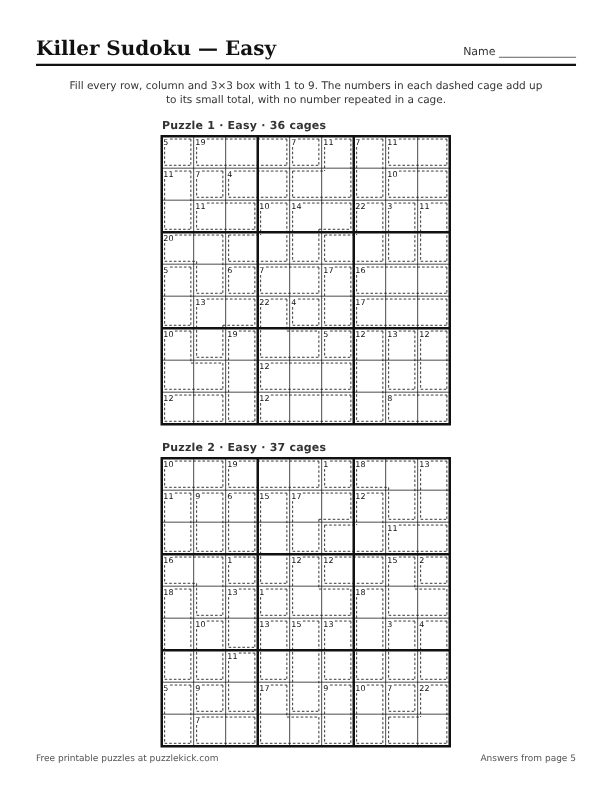
- Dashed lines outline the cages. The small number in the top-left corner of a cage is the total of all its squares.
- A number can appear only once inside a cage, even when the cage reaches across two boxes.
- No numbers are given at the start. Everything comes from the cage totals, so a cage of one square simply tells you its number.
New to sudoku itself? Our how to play sudoku guide shows the basic moves with pictures. Killer sudoku uses the same moves, plus a little adding up.
How to solve killer sudoku
1. Start with cages that have only one combination. Some totals can be made in just one way. Two squares that add up to 3 must be 1 and 2; two squares that add up to 17 must be 8 and 9. You do not know yet which square gets which number, but those two numbers are now taken for that row, column or box. The cages of two squares with one combination are 3 = 1 + 2; 4 = 1 + 3; 16 = 7 + 9; 17 = 8 + 9. The killer sudoku cheat sheet lists every combination, for every cage size.
2. Look at small and large totals. A cage of three squares with a total of 6 can only be 1, 2 and 3; a total of 24 can only be 7, 8 and 9. Totals near the middle have many combinations, so leave them for later.
3. Use the 45 rule. The numbers 1 to 9 add up to 45, so every row, every column and every box adds up to 45. Add up the cages that lie wholly inside a row. If one square of the row is left over, its number is 45 minus that sum.
4. Squares that poke out work too. When the cages covering a row stick out by one square, that square is the total of those cages minus 45. The same trick works for two or three rows or columns together (90 or 135), and for boxes.
5. Lock numbers in a row or box. If a cage must contain a number, and every square of that cage where the number could go is in the same row or box, that number is off-limits everywhere else in that row or box.
6. Keep pencil marks. Write the possible numbers small in a corner and cross them off. When a cage has few combinations left, write only the numbers those combinations use.
Which level should I choose?
| Level | Cages | What it takes | Time |
|---|---|---|---|
| Easy | about 38, up to 3 squares each | Small cages, some of a single square. Cage combinations and the usual “one number fits” and “only place” steps are enough. A good first killer sudoku. | 20–35 min |
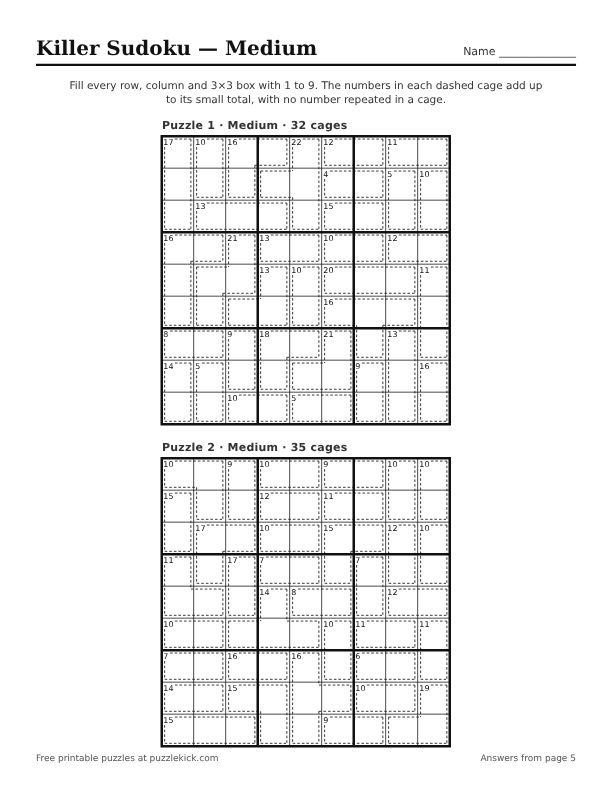
| Medium | about 32, up to 4 squares | Bigger cages and no single squares to start from. You will need the 45 rule at least once. | 35–60 min |
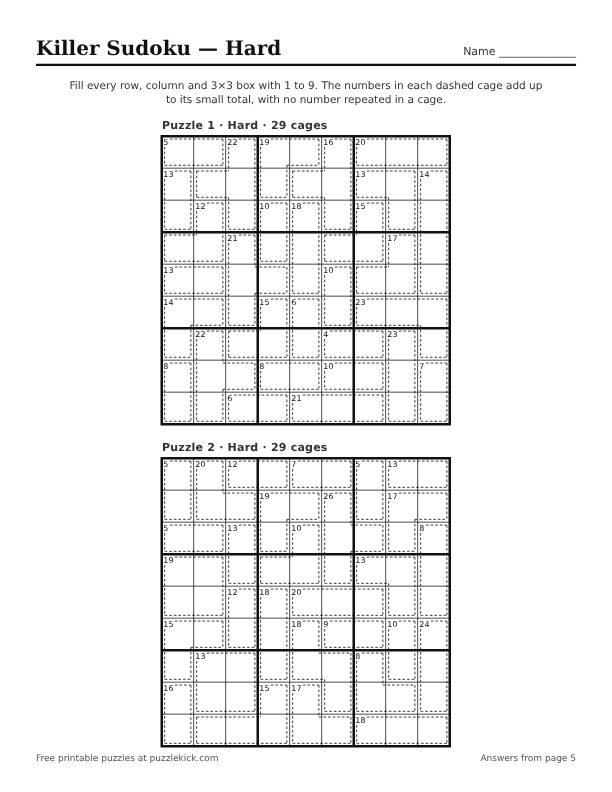
| Hard | about 28, up to 5 squares | The 45 rule again and again, over one, two or three rows or columns, plus number locks. Still no guessing. | 45–90 min |
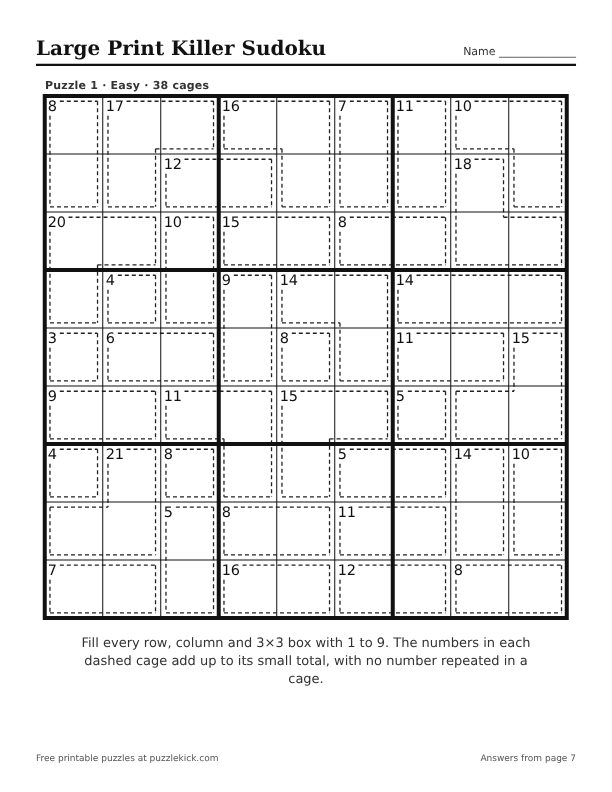
| Large print | about 38 | Easy puzzles, one per page, with squares about 0.8 inch wide and bigger cage totals. | 20–35 min |
Large print killer sudoku for seniors
The small totals in the corners are the hardest part to read, so the large print PDF gives one easy puzzle per page, with big squares, bigger totals and clear dashed cages. It is a friendly next step for anyone who already enjoys our large print sudoku and likes a bit of adding up. Activity leaders can print a stack for a puzzle table; the answers are at the back. Keep a printed cheat sheet next to it, so nobody has to work out the combinations in their head.
Printing tips
The level PDFs fit two puzzles on a US Letter page, with squares close to half an inch wide. On A4 paper, choose “Fit to page” in the print window. Cages are dashed black lines, so the sheets print clearly in black and white. On screen the cages are also tinted in soft colors; that is only to help your eye.
Questions
What is killer sudoku?
A sudoku with no starting numbers. The grid is divided into cages, each with a total. You fill in 1 to 9 so that every row, column and 3x3 box has each number once, every cage adds up to its total, and no number repeats inside a cage.
Can a number repeat inside a cage?
No. Inside a cage every number is different, even when the cage stretches over two boxes. That is why a cage of two squares with a total of 4 must be 1 and 3, not 2 and 2.
What is the 45 rule in killer sudoku?
The numbers 1 to 9 add up to 45, so every row, column and box adds up to 45. If you know the totals of the cages that fill most of a row, the squares left over must make up the difference. It is the most useful trick in killer sudoku.
Is killer sudoku harder than regular sudoku?
It feels different more than harder. You start with an empty grid, so the first steps come from adding up rather than from given numbers. Our easy puzzles use small cages and are a gentle introduction; the hard ones need the 45 rule many times.
Is there only one correct answer?
Yes. Every puzzle is solved by computer with simple human steps alone and then checked again by a separate search, so each one has exactly one solution and never needs guessing.
Can I print copies for my group or class?
Yes. The puzzles are free for personal, classroom and group use, such as clubs, libraries and senior centers.