The rules
A sudoku is a grid of 81 squares: 9 rows across, 9 columns down, and nine boxes of 3×3 squares, marked by the thicker lines. Some squares already have numbers. Your job is to fill in the rest.
- Every row must hold each number from 1 to 9 once.
- Every column must hold each number from 1 to 9 once.
- Every 3×3 box must hold each number from 1 to 9 once.
That is all. Since each row, column and box has exactly nine squares, a number can never appear twice in any of them. Every puzzle on our site has exactly one solution, and you never need to guess.
Your first moves, step by step
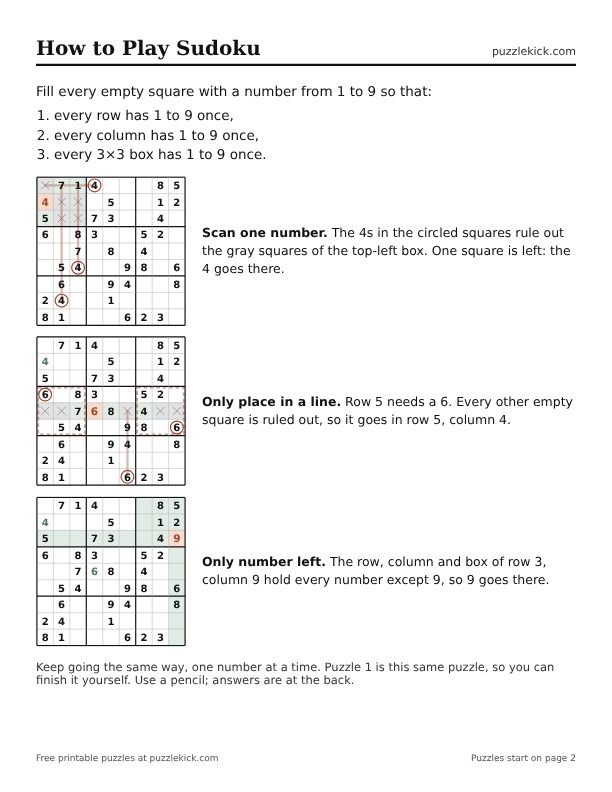
Here is a real easy puzzle from our site. The numbers in black were given at the start. We will fill in three squares together, each one with a different kind of move. Rows are counted from the top and columns from the left.
Move 1: one number, one box
Pick one number and follow it around the grid. Here we take the 4s. The top-left box has no 4 yet, and 3 of its nine squares are already filled. A number can never repeat, so the 4 in row 1, the 4 in column 2 and the 4 in column 3 rule out 5 of the 6 empty squares (shaded gray). Only one square is left, in row 2, column 1, so the 4 goes there.
Players call this scanning or cross-hatching. It is the most useful move in sudoku: run your eye along the rows and columns that cross a box, and the empty squares that are left tell you where the number goes.
Move 2: the only place in a row or column
The same idea works along a single row or column. Row 5 still needs a 6. A number can never repeat, so the 6 in column 6, the 6 in the middle-left box and the 6 in the middle-right box rule out 5 of the 6 empty squares (shaded gray). Only one square is left, in row 5, column 4, so the 6 goes there.
A box, a row and a column all work the same way: when a number has only one possible place left in any of them, it must go there.
Move 3: the only number left in a square
Now look at one square at a time. Take the empty square in row 3, column 9. Its row already has 3, 4, 5 and 7. Its column has 2, 5, 6 and 8. Its box has 1, 2, 4, 5 and 8. Put those together and every number from 1 to 9 is used except 9, so 9 is the only number that can go in this square.
This move works best on a square whose row, column and box are nearly full. Very easy puzzles can be finished with this move alone.
Keep going. Each number you write in gives you new information, so the moves get easier as the grid fills up. Every empty square in this puzzle can be filled with these three moves, one after another, with no guessing. You can print it on the first puzzle page of the beginner’s pack and finish it yourself.
Pencil marks: writing down what is still possible
When no move jumps out at you, write the possible numbers in small print in the corner of each empty square. These are called pencil marks, notes or candidates. In the picture, the square in row 7, column 7 can only be 1 or 7.
As you fill in a square, erase that number from the pencil marks in its row, column and box. Before long, a square is left with a single mark, and that is your next number. Use a pencil with a good eraser, or the notes button in an app.
Tips for when you get stuck
- Go number by number. Scan for all the 1s, then all the 2s, and so on up to 9. Moves hide in plain sight until you look for one number at a time.
- Start with the fullest places. A row, column or box with seven or eight numbers is the quickest to finish.
- Count what is placed. If eight 4s are already in the grid, the ninth has only one row, one column and one box left.
- Never guess in ink. A guess can look right for a long time and then fall apart. In our puzzles there is always a move that does not need one.
- Check a mistake carefully. If two of the same number turn up in a row, column or box, go back to the last few squares you filled and look for the one you were not sure of.
- Take a short break. A fresh look after a cup of coffee often finds the move you missed.
Three moves for harder puzzles
Easy and medium puzzles on our site need only the three moves above. Harder puzzles in books and newspapers also use moves like these, which work on the pencil marks:
- Naked pair. If two squares in the same row, column or box can only be the same two numbers, say 3 and 8, those two numbers belong to those two squares. Cross 3 and 8 off every other square in that row, column or box.
- Pointing pair. If, inside one box, a number can only go in squares that all sit in the same row, the number must end up in that row inside this box. Cross it off the rest of that row outside the box. The same works for a column.
- X-wing. Look for one number that has exactly two possible squares in each of two rows, and those four squares sit in the same two columns, making the corners of a rectangle. The number must take two opposite corners, so it fills both of those columns, and you can cross it off every other square in those two columns. The same works with rows and columns swapped.
Beyond these come moves with names like swordfish and coloring, used in the hardest puzzles. You will not need any of them for the puzzles on this site, but they are fun to read about once the basics feel easy.
Try an easy puzzle now
This one is very easy: every square can be solved with move 3. Tap a square and type a number. When you are ready for more, switch to Easy.