How to play 4x4 sudoku
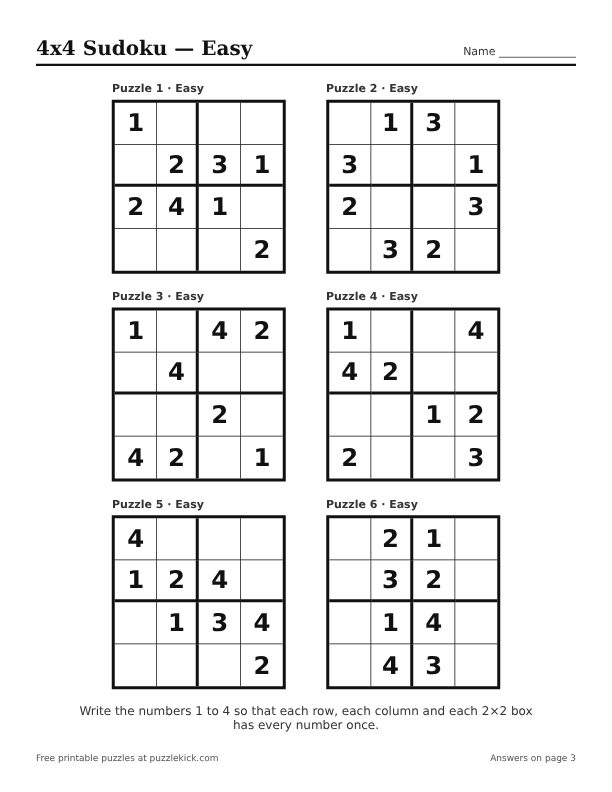
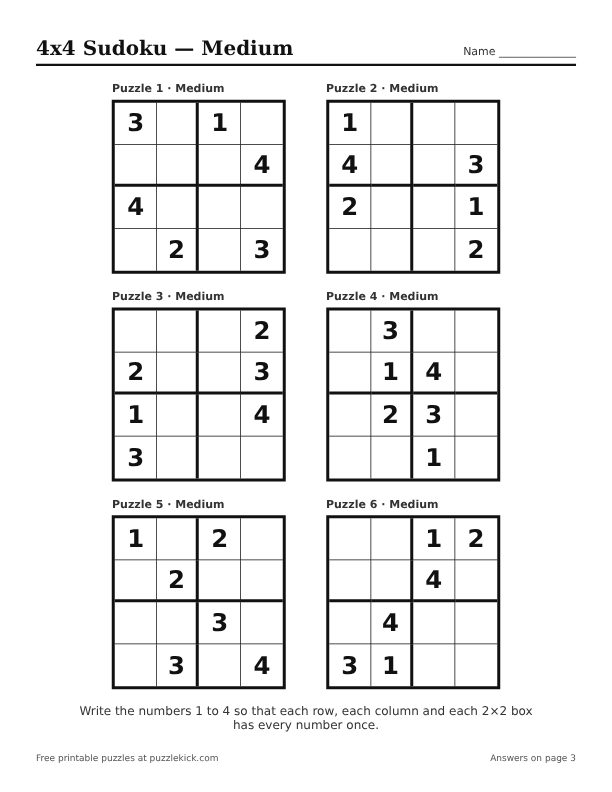
- The grid has 4 rows, 4 columns and four boxes of 2×2 squares (the thick lines).
- Write a number from 1 to 4 in every empty square.
- Each row needs 1, 2, 3 and 4, once each. So does each column, and so does each box.
- Look for a row, column or box with three numbers already there: the missing one goes in the empty square.
Why start with a 4x4 grid?
A full 9×9 sudoku has 81 squares, and that is a lot for a young child to keep track of. The 4×4 version has only 16 squares and four numbers, so children can check every rule with a finger and see the whole puzzle at once. It is a good first logic puzzle for kindergarten and first grade, and a quick warm-up for older kids.
The Easy puzzles give 8 of the 16 numbers, and every empty square can be filled straight away by looking at its row, column and box. The Medium puzzles give only 6 numbers, so children have to think one step further: where can the 3 go in this box?
Ideas for teachers and parents
- Math centers: one sheet of six puzzles makes a calm, self-checking activity; the answer key is on the last page.
- Pictures instead of numbers: for pre-readers, ask children to draw a dot, a line, a circle and a star in place of 1, 2, 3 and 4.
- Talk it through: ask “How do you know it’s a 2?” Explaining the reason is the real skill sudoku builds.
- Next step: once 4×4 feels easy, move on to 6x6 sudoku, then to easy 9x9 sudoku.
Questions
What age is 4x4 sudoku for?
Most children can start at about age 5 or 6, once they know the numbers 1 to 4. Adults and older kids use it as a quick warm-up.
Is there only one correct answer?
Yes. Every puzzle is checked by computer to have exactly one solution, and the answer key shows it.
How is it different from regular sudoku?
The rules are the same, but the grid is 4 by 4 with boxes of 2 by 2, and you use only the numbers 1 to 4 instead of 1 to 9.