How to play samurai sudoku
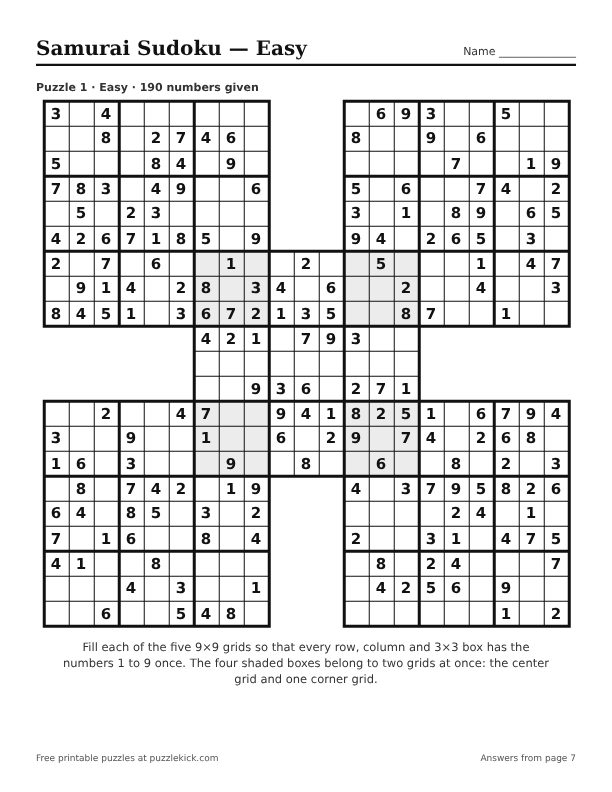
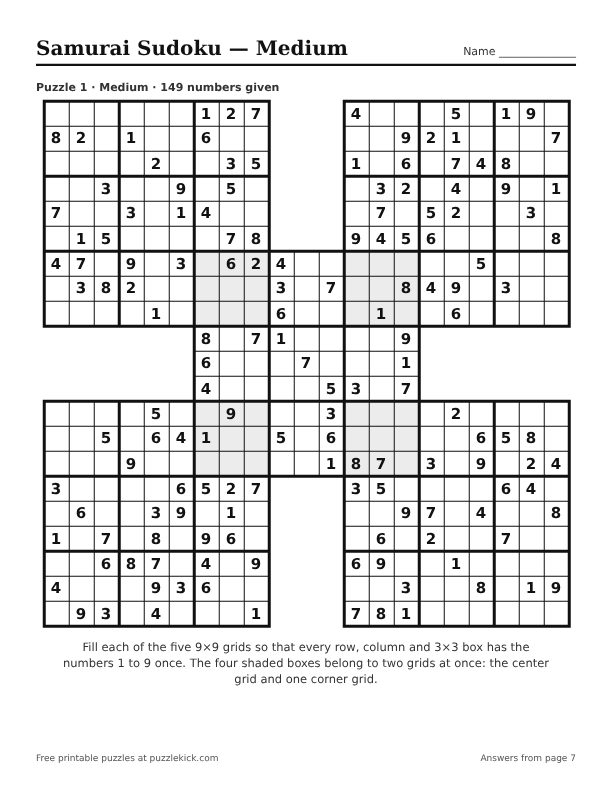
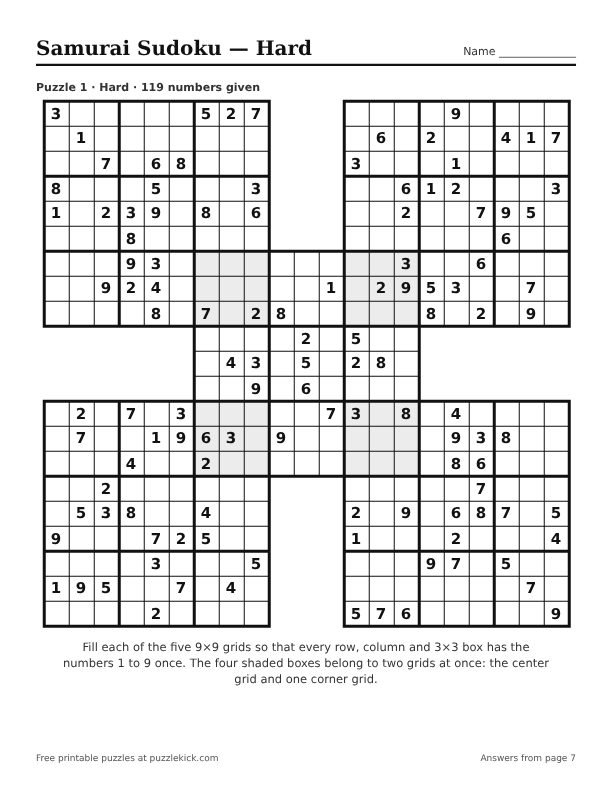
- The board holds five 9×9 sudoku grids: four in the corners and one in the center, 369 squares in all.
- Each grid follows the usual rules: every row, every column and every 3×3 box has the numbers 1 to 9, once each.
- The center grid shares one corner box with each outer grid. A number in a shared box counts in both grids, so it has to fit both.
- Rows and columns stop at the edge of their own grid. A row of the top left grid does not carry on into the top right grid across the gap.
New to sudoku itself? Our how to play sudoku guide shows the basic moves on a real puzzle, with pictures. Samurai sudoku uses exactly the same moves.
Where to start
- Pick the fullest grid. The clues are spread over all five grids. Start wherever you see the most numbers; it is often a corner grid.
- Work one grid at a time. When you scan a row or a column, look only inside the grid you are working on. It is easy to run your eye across the gap into the next grid by mistake.
- Use the shared boxes from both sides. A square in a shared box is limited by the rows and columns of two grids, so it often has fewer possible numbers than its neighbors. These squares are good places to look when you are stuck.
- Finish a shared box early. A completed shared box hands nine numbers to the next grid, which often opens it up.
- Use pencil marks. With 369 squares, it helps to jot small possible numbers in a corner of a square and erase them as the grid fills.
- Take breaks. A samurai is a long puzzle. You can solve one grid per sitting and come back to it over a few days.
Which level should I choose?
| Level | Numbers given | What it takes | Time |
|---|---|---|---|
| Easy | about 190 of 369 | Every empty square can be filled once you rule out the numbers already in its row, column and box. A good first samurai. | 1–1½ hours |
| Medium | about 150 | Fewer clues, and you will also need the “only place” step: a number that fits in just one square of a row, column or box. | 2–3 hours |
| Hard | about 120 | Fewer clues still and many “only place” steps. Still no guessing. | 3 hours or more |
A puzzle for a group
Samurai sudoku works well as a team puzzle. Print one copy for the table and give each person one grid. Whoever fills a shared box calls out the numbers, and the player on the other side of the box carries on from there. It makes a calm, chatty activity for a puzzle club, a family evening or a senior center, and the answer key at the back lets the leader check the finished board.
Printing tips
Each puzzle fills a US Letter page, with squares about a third of an inch wide, close to a newspaper sudoku, and thick lines around every 3×3 box and every grid. For bigger squares, print on 11×17 inch paper with “Fit to page” selected: the squares grow to almost half an inch. On A4 paper, choose “Fit to page” as well. The answers are at the back of each PDF, two to a page.
If you prefer one regular grid in really large print, see our large print sudoku with one big puzzle per page.
Questions
What is samurai sudoku?
A sudoku variant made of five standard 9x9 grids that overlap: one grid in each corner and one in the center, sharing a 3x3 box with each corner grid. Some books call it five-grid or overlapping sudoku. Each grid follows the normal sudoku rules.
Is samurai sudoku harder than regular sudoku?
It needs the same moves as a regular sudoku, so it is mostly longer rather than harder. Our easy samurai can be finished with the simplest move alone. The shared boxes add a little extra thinking, because each of their squares has to suit two grids.
How many numbers do I have to fill in?
The board has 369 squares. Our easy puzzles give about 190 of them, medium about 150 and hard about 120, so you fill in roughly 179 to 249 squares.
Is there only one correct answer?
Yes. Every puzzle is checked by computer to have exactly one solution, and the answer key shows it. You never need to guess.
Can I print copies for my group or class?
Yes. The puzzles are free for personal, classroom and group use, such as clubs, libraries and senior centers.